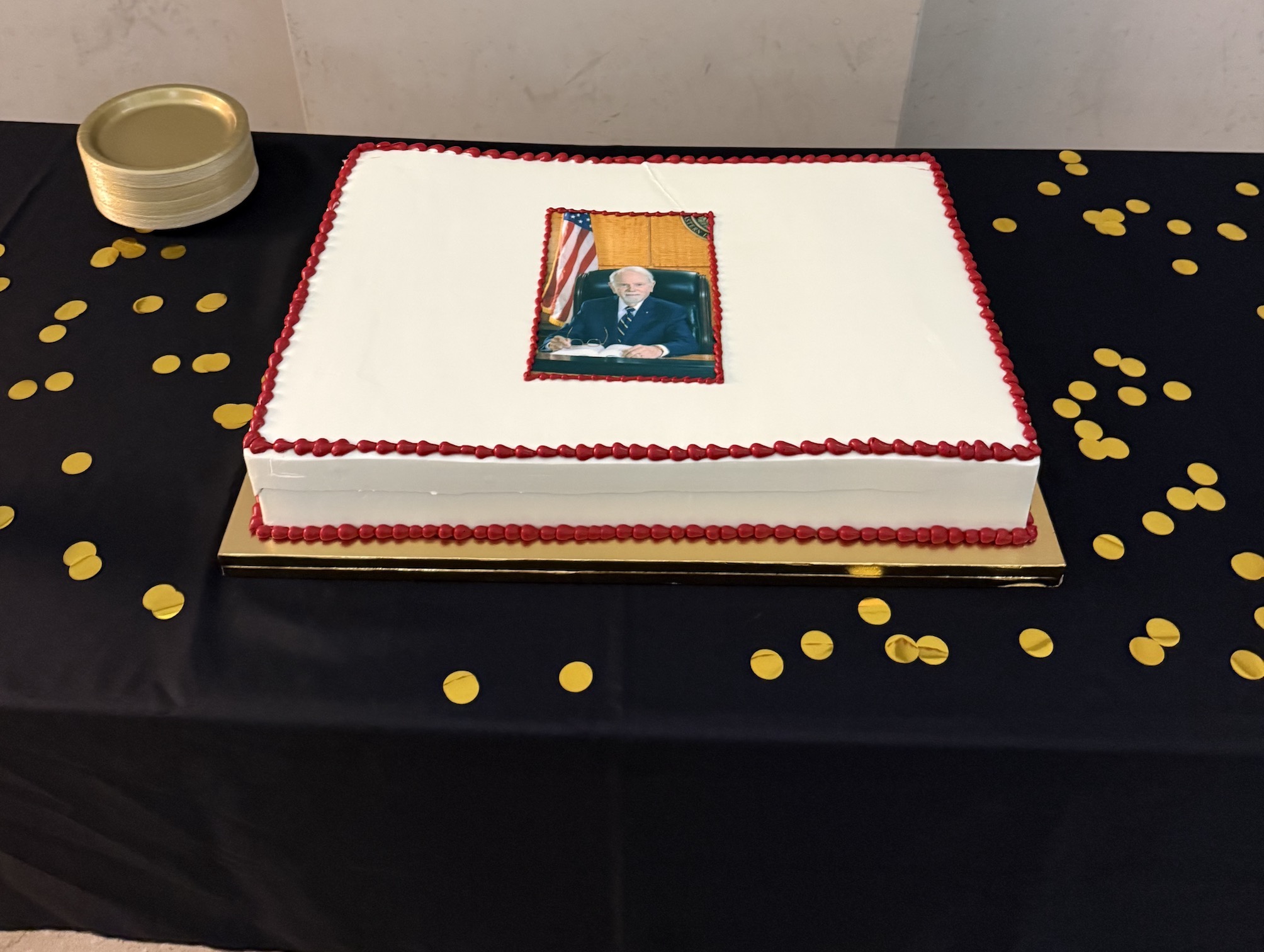
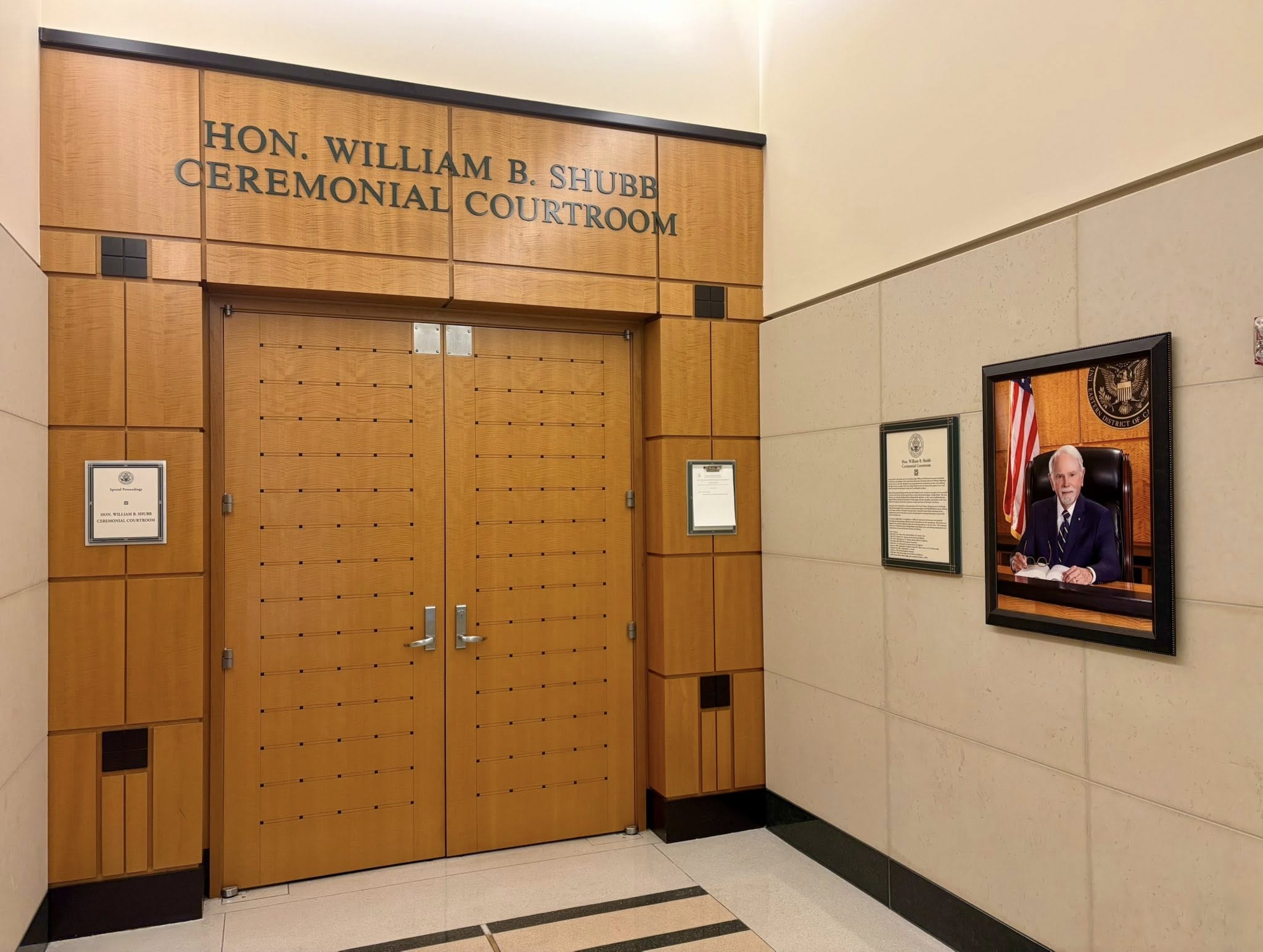
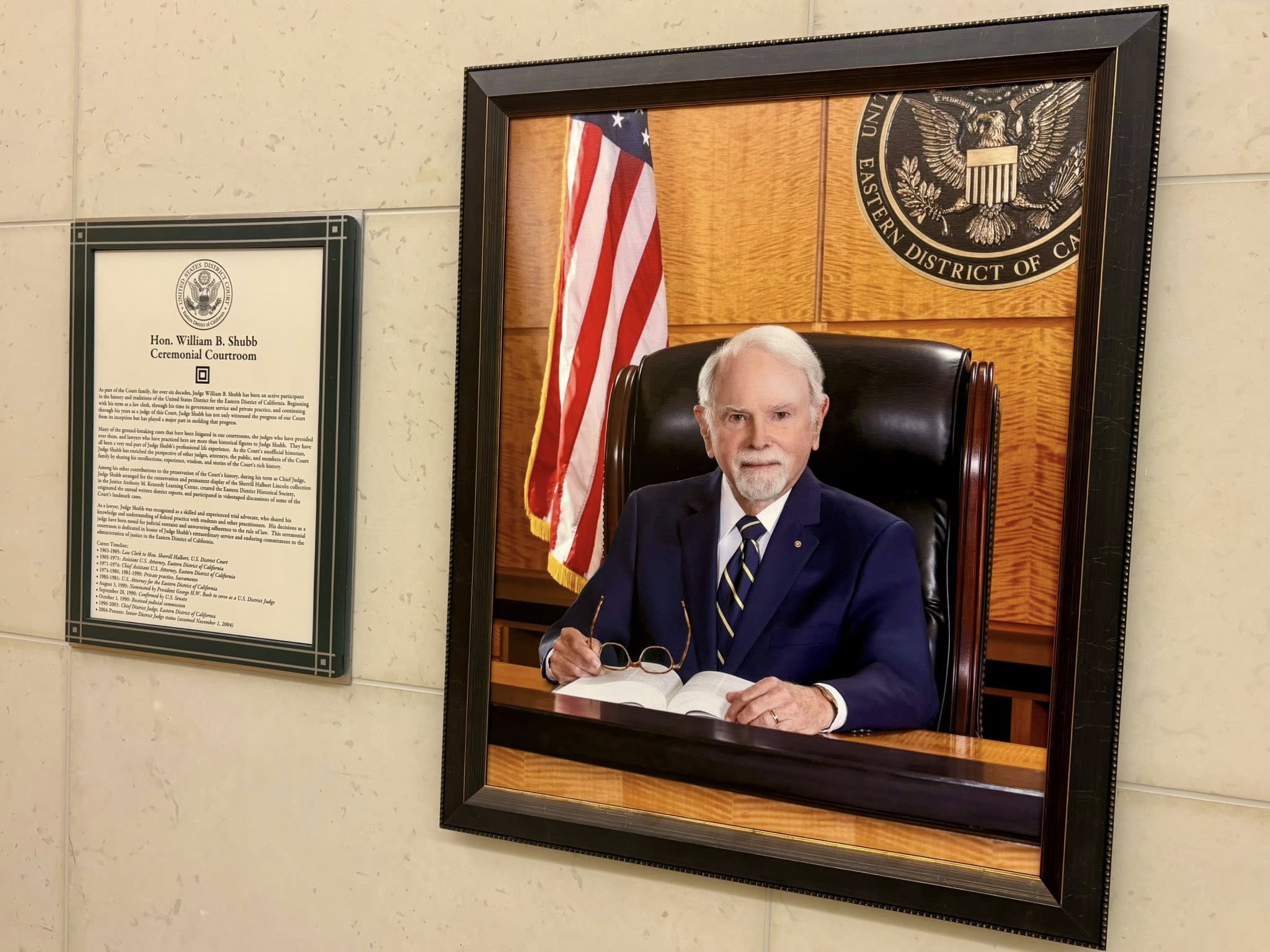
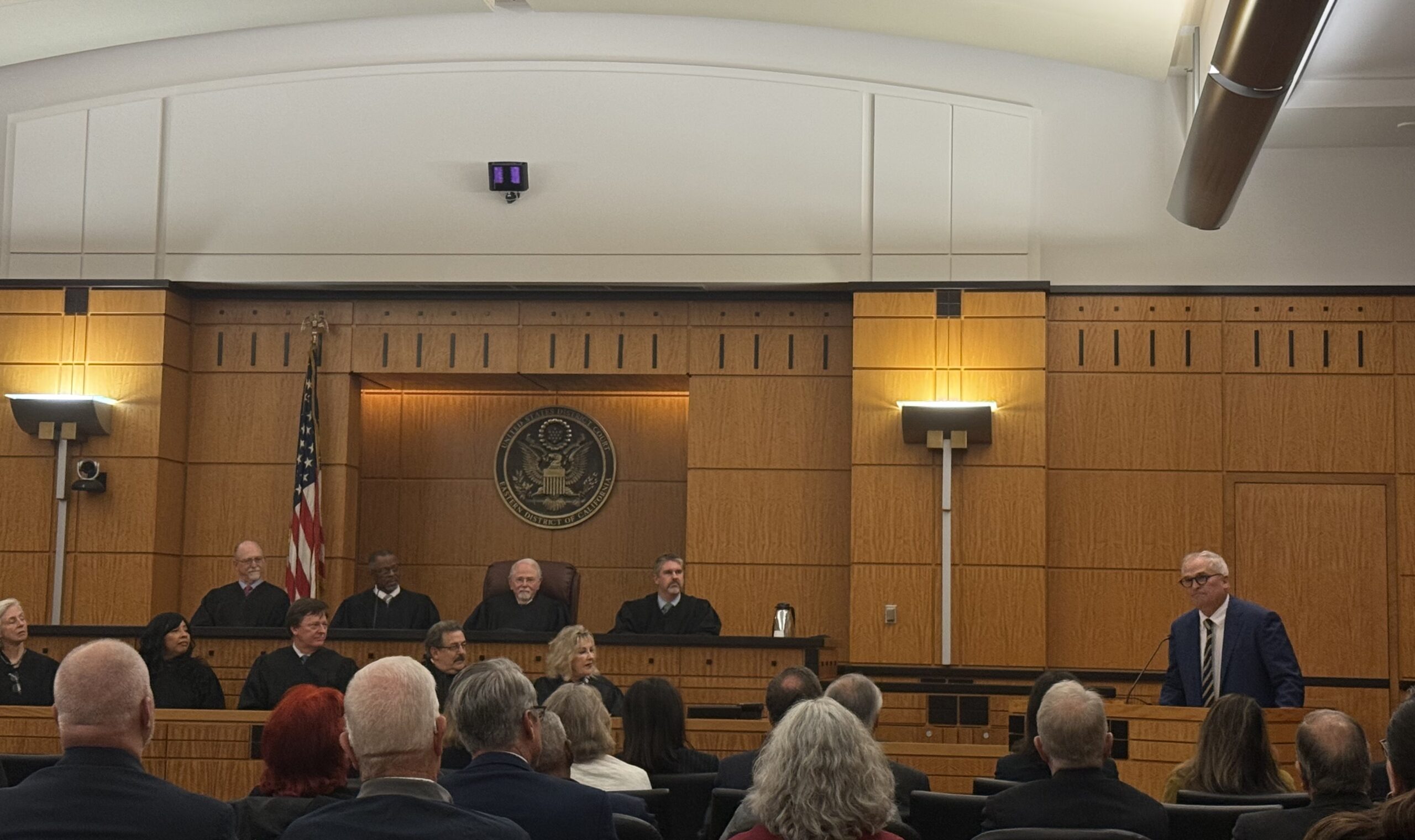
The William B. Shubb Ceremonial Courtroom was dedicated by extraordinary proceeding called to order at noon on November 5, 2026. Bench, bar, clerks, colleagues, classmates, and the extended Shubb family traveled from across the country to fill the Eastern District’s largest courtroom. Chief District Judge Nunley presided. Remarks by former law clerks Breanne Moebius and Courtney Linn, Chief Magistrate Judge Delaney, and District Judges Drozd and Mueller were punctuated by personal reflections and a touching expression of gratitude from the man of the hour.
William B. Shubb Ceremonial Courtroom Dedication
November 5, 2025
Remarks of Courtney J. Linn
May it please the Court. Good afternoon.
My clerkship with Judge Shubb started when he was sworn in as a United States District Judge, just about 35 years ago to this day. I remember his investiture, not so much for what I heard said in the actual ceremony, but for what I observed behind the scenes. Senior District Judge Sherill Halbert made the trip to Sacramento from San Rafael to see his former law clerk take the oath of office. Judge Halbert was in an assisted care facility at the time and would pass away the next year. I overheard Judge Halbert joke with Judge Shubb before the investiture ceremony about how he had recently been moved down a floor in the assisted care facility–the lower the assigned floor, Judge Halbert said with mock gloom, the worse his prognosis.
Ninth Circuit Judge Cecil Poole was Judge Shubb’s former boss in the U.S. Attorney’s Office. Judge Poole made the drive from San Francisco for the investiture, but he was delayed in arriving. At the appointed time, the judges were all assembled in their robes in the waiting area of Judge Shubb’s chambers on the 2nd floor of the old courthouse on Capitol Mall. There was a court full of people and the judges pressed to get started without Judge Poole. Judge Shubb said “no, I want to wait for Cecil.” And so, they waited. It was Judge Shubb’s first declaration of judicial independence.
I call attention to Judges Halbert and Poole because they helped shape Judge Shubb’s legal and judicial career. Judge Shubb once said to me that he learned what it was to be a judge from Judge Halbert, and he learned what it was to be a prosecutor from Judge (then U.S. Attorney) Poole. Judge Halbert was a study in judicial restraint and fairness—never deciding more than the dispute that was before him and treating everyone who came before him with dignity. As a U.S. Attorney, Cecil Poole modeled for the Assistant U.S. Attorneys in his office the behaviors of an outstanding lawyer and prosecutor.
In my time clerking for Judge Shubb, he was the most relaxed and approachable in the late afternoons, after he felt he had accomplished a full day’s work. That, I learned, was the best time to get him to tell wonderful stories about Judges Halbert, Poole, and others. At the time, I thought of these stories as humorous but isolated anecdotes–funny stories about Judge Shubb’s days as a law clerk, as a prosecutor in the U.S. Attorney’s Office, and as a lawyer in private practice. Reflecting on those stories today, I see a common thread that runs through them. The stories convey Judge Shubb’s sense of humanity, humility, and humor. To one of these stories, he might tack on a life lesson. For instance, I once told him how proud I was as a lawyer to say in court that I was appearing on behalf of the United States. He responded I should be equally proud to state my appearance on behalf of a private client.
Judge Shubb connects us to this court’s past and its future. He was there when the district formed, waiting for the new clerk’s office to open its doors so that he could be one of the first attorneys admitted to the district. He was instrumental in creating the district historical society and securing permission from McGeorge School of Law for the Lincoln Collection to be displayed downstairs. And today Judge Shubb mentors the judges who represent the Court’s future.
Judge Shubb embodies the values and virtues of an independent federal judiciary. He follows the law, reaching decisions he often disagrees with at a personal level. He’s a clear and independent thinker. He treats every individual who appears before him with equal respect, whether they represent themselves or are affiliated with a prestigious law firm.
I remember a conversation with Judge Shubb many years ago in which I asked him why he became a judge. He said his career as a lawyer had been satisfying, but that being a judge held the potential to be something more fulfilling, adding: “when you’re done practicing law, the community won’t remember you for very long. But being a judge, they might remember you longer.” With the dedication of this courtroom, this very public and honorable space, we honor Judge Shubb now and into the future.
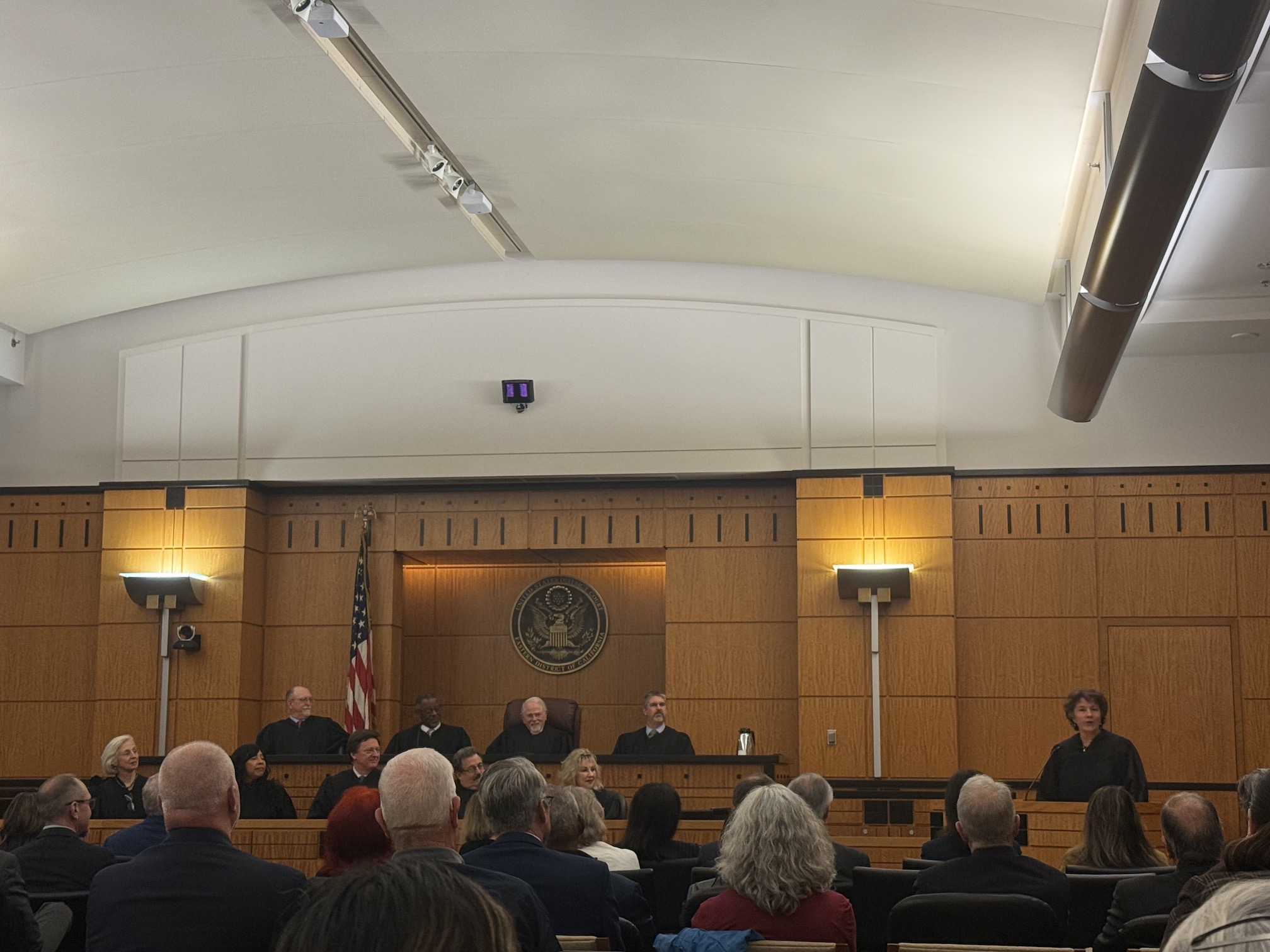
Remarks of Magistrate Judge Carolyn K. Delaney
Good afternoon, it is both an honor and a privilege to stand here today as we dedicate this courtroom in honor of the Honorable William B. Shubb, a jurist whose wisdom, integrity, and steadfast devotion to justice have shaped not only this courthouse but generations of lawyers, judges, and citizens who have appeared before him.
We are thrilled to be joined by Judge Shubb’s family, friends, colleagues from the bench and bar, and many who have had the privilege of working for and alongside him. Your presence is a testament to the deep respect and affection that Judge Shubb has earned through his remarkable career.
Judge Shubb’s journey through the law reflects both dedication to public service and a profound love of justice.
Before his appointment to the federal bench, he served with distinction as an Assistant United State Attorney before the Eastern District was a thing – he was literally here when it came into being, having been hired by the great Cecil Poole, despite his reported reservations that Judge Shubb was too young for the position of an AUSA. Nonetheless, he earned a reputation for his sharp legal mind, his fairness, and his unwavering sense of duty. He later entered private practice, bringing that same sense of professionalism and balance to the clients he served and the colleagues he mentored.
When he was appointed to the United States District Court, Judge Shubb brought with him not only exceptional legal ability, but also a deep understanding of the people and the principles that our system of justice is built upon. In his courtroom, every voice is heard, every argument considered, and every decision rendered with care, humility, and a respect for the rule of law.
As he said recently in a panel discussion, the thing he works hardest at, every day, on every case, is “getting it right.” And part of getting it right for Judge Shubb is an understanding and appreciation of the history of our district, its judges, practitioners, community, and cases. In that vein Judge Shubb established the Eastern District Historical Society in 2001 and long before website design services like Square Space existed, he created and populated its website. The Historical Society is ongoing, and I am delighted to report today that after a period of inactivity that website is now refreshed and available for viewing, with many thanks to Alexander Nowinski for guiding the project to completion.
Those who have practiced before Judge Shubb, as I have, know that his courtroom is a place of rigor – where preparation matters, candor is expected, and fairness is never in doubt. Beyond the bench he has been a mentor and teacher to me and many others. He has always offered genuine encouragement and guidance. And I, as one among many, am eternally grateful for his clear counsel, and excellent advice.
And so today, it is only fitting that we dedicate this beautiful courtroom to The Honorable William B. Shubb. May every person who steps through these doors – lawyer, litigant, or citizen – feel the presence of his example and the weight of his legacy. Let this space stand as a living tribute to a man who has embodied the best of our profession: an unshakable belief in the power of the law to serve the public good.
On behalf of the court and the community, we thank you Judge Shubb for your decades of service, for your wisdom and work ethic, and for reminding us every day what it means to do justice honorably. May this courtroom – your courtroom – continue to reflect the values you uphold and the respect you inspire.

Remarks of Judge Drozd
Our Colleague, Bill Shubb who we are here to honor today, is obviously deeply rooted in the history of the Eastern District California – for starters, he was working in this court before the Eastern District was even created in 1966!
A bit of historical review reveals just how deep Bill’s roots run in this court. He graduated from Boalt Hall School of Law in Berkeley in 1963. Upon graduation he was able to secure a highly sought after position as a law clerk to the Honorable Sherrill Halbert for whom he clerked from 1963-65 here in Sacramento in what was then part of the Northern District of California.
In 1965, upon completion of his clerkship, Bill was hired as an AUSA in the office then headed by John Hyland. Bill would remain in the U.S. Attys. Office in this District until 1974 and was one of their go to trial attorneys. In 1970 was named by then U.S. Atty. Duane Keys as the Chief Asst. of that office.
In 1974 Bill embarked on his career in the private of law, joining one of Sacramento’s then most well-known and respected law firms – Diepenbrock, Wulff Plant & Hannigan–where he thrived and became known as one of the Dean’s of the Sacramento legal community.
There was a bit of a detour to that career in private practice, however, when in 1980 the judges of this court asked that Bill accept the position as the court appointed U.S. Attorney for this district. Of course, he accepted and held that position into 1981 before returning to private practice. It was during this period when I first met Bill because I had come to Sacramento in 1980 to clerk for District Judge Lawrence K. Karlton (with whom Bill shared a May 28 birthday!)
During this period of time in private practice in the 1980s Bill, my partner Clyde Blackmon and I even had a client or two in common. Bill was nominated to serve as a District Judge in this court by President George H.W. Bush and was confirmed by the U.S. Senate on September 28, 1990. He has proudly served as a District Judge ever since, including serving as the Chief Judge of the Court from 1996-2003. In the 1990’s I appeared before Bill on a regular basis and tried cases before him. He has always been known as a great trial judge. If you knew what you were doing, he definitely let you try your case. Now, if you didn’t know what you were doing, his was not necessarily the courtroom you wanted to be in!
On a personal level, Bill has played an important role in my own career. He was the Chief Judge of the court when I was appointed as a magistrate judge in 1997 and without his support that would not have happened and as a result I most likely would not have my current position as a district judge. He is a fantastic colleague and mentor and has given me and others judges of the court invaluable advice – such as providing tips as to how to work oneself out of an inherited case backlog as quickly as possible – advice I followed with a degree of success, though not as efficiently as Bill who has always been incredibly efficient.
Judge Muller is also going to speak about Bill’s career on this court. I’ll just say this, my colleague Bill Shubb is a rare one and we are so fortunate to have him and to have all benefitted so much from his constant presence on and contributions to this bench. This is a very fitting dedication day. To paraphrase Bill’s remarks at my own investiture 10 years ago – “Bill Shubb belongs here and has always been at home here, on this court – he has it in his blood.”
Congratulations Bill.
Remarks of District Judge Kimberly J. Mueller
Like Judge Drozd, I probably would not be a member of this bench if it weren’t for Judge Shubb — I don’t think I needed his decisive vote, but for other reasons. I’ll let you be the judge of whether that’s a good thing or not, but it’s another measure of the mark Judge Shubb has left on this honorable court.
Judge Shubb, your presence has been a constant my entire life in the law. As a law school extern for Judge Levi, I was a nobody, but I remember you stopping by chambers at the end of the day to share a war story or marvel (or vent) at a turn in a case. From your tone of voice and the elevated repartee, I could tell how engaged you were in the work, how collegial, how keenly interested, how alive as a judge.
As an associate in private practice, my cases very often were before you. Random assignment is not equal it turns out! My early appearances in your courtroom, first at 650 Capitol Mall and then here at the Matsui Courthouse, contributed to my falling in love with our federal court and federal practice. The air in that courtroom seemed so rarified! Even when we were on the losing end of a decision, I always felt listened to and understood, and respected the explanation. This is not to say I wasn’t completely terrified walking into any given hearing. I knew you had high standards and always worried I wouldn’t make the grade.
I must have passed some kind of test because as Chief Judge, you assigned me as co-chair of our court’s annual conference, with Greg Durbin in Fresno. We had a great lineup — David Boies and Clint Eastwood. But you of course demanded 2 more — specifically that I play the mean lady host for a spoof of the Weakest Link, during which we would roast our newest Magistrate Judges at the time, Judge Drozd and Judge O’Neill. You are the real ham with a flair for performance, but I obliged, spraying my hair bright red, donning a black leather jacket. I really had no choice. Maybe this is what really earned me my stripes?
As a member of the bench, first as a Magistrate Judge — sworn in in 2003 by thenChief Judge Shubb — and now as a District Judge, I’ve come to know you as a colleague. And my respect and appreciation has only grown. Your engagement and interest in the work of the federal trial court is unceasing. You are hands down the most experienced trial lawyer and judge on our court – no one will ever catch you! — and you are a generous teacher in sharing the many lessons you’ve learned with junior colleagues, including yours truly. Your high standards never waver, and while you can get exercised about something on occasion, it’s because you care and know you have a perspective worth registering. You embody a broad-mindedness and originality of thought that’s admirable and at times surprising. In expecting the best from all of us you often serve as the conscience of the court. And the performer in you can tell a well-timed story to put things in perspective and make us laugh when that’s what’s needed most.
I’ve found myself remembering one story you shared with me quite a few years ago. I probably have blurred the details but you can correct me later. You described being a student at what was then Boalt School of Law, where you did well. So well that a professor encouraged you to pursue a coveted clerkship. You applied and were offered an interview. The judge came to campus and Bill Shubb the law student was told to meet him there on the front steps. As you got to those steps, you looked up and saw an imposing, distinguished well-dressed man and 3 thought to yourself, “Now there’s a judge!” Judge Sherrill Halbert, a judge to serve well and to emulate, and who gave you the first job out of law school that brought you and Sandy to Sacramento where you’ve put down roots and raised your family — and the rest is history.
Judge Shubb, your life in the law and the life of this court are so intertwined, such that one cannot exist without the other. You were here before the beginning, and at the creation. As a distinguished member of the bar you covered all the bases, civil and criminal, and as a federal trial judge for more than 35 years you have embodied the reasons and ideals animating Article III as an independent branch. It is so fitting that our court’s ceremonial courtroom will now bear your name forevermore, as a lasting tribute and in recognition of your many contributions as a judge’s judge. Here’s to you, dear friend and colleague. My heartiest congratulations! Thank you thank you for all you’ve done and who you are!
Judge Drozd and I say Bravo! Brava!